
Text: HONG TzeNing
A Workshop for EVERYONE
For me, an art-related workshop designed for EVERYONE would be challenging. However, during the humid and pandemic summertime, I joined an online “Drawing Workshop", which made me very impressive- and it was fun! The “Tropical plant and landscape in Indonesia neighbourhood" workshop, hosted by SUAVEART, under its Seeding Future project.
Here’s how they constructed this relaxing while trying something new for participants: all participants could be included because they offer two types of content at one time and guided/accompanied participants to take these aspects applied on their memory. These two contents, from researcher Trevor Padgett, we got to know how to look at plants carefully in detail; from artist Aliansyah Caniago, how to turn those we saw into the things we could draw, with personal or art perspective. Lastly, everything connected to the core of the project, which reminds me of the sharing by YiPei and Sherry. In short, as individual participants, we only need to bring one story of plant/landscape, plus any tools for drawing. The following is how it works! And the story I bring was about Coleus Amboinicus.


Observing to Look into Details, Expressing via Drawing
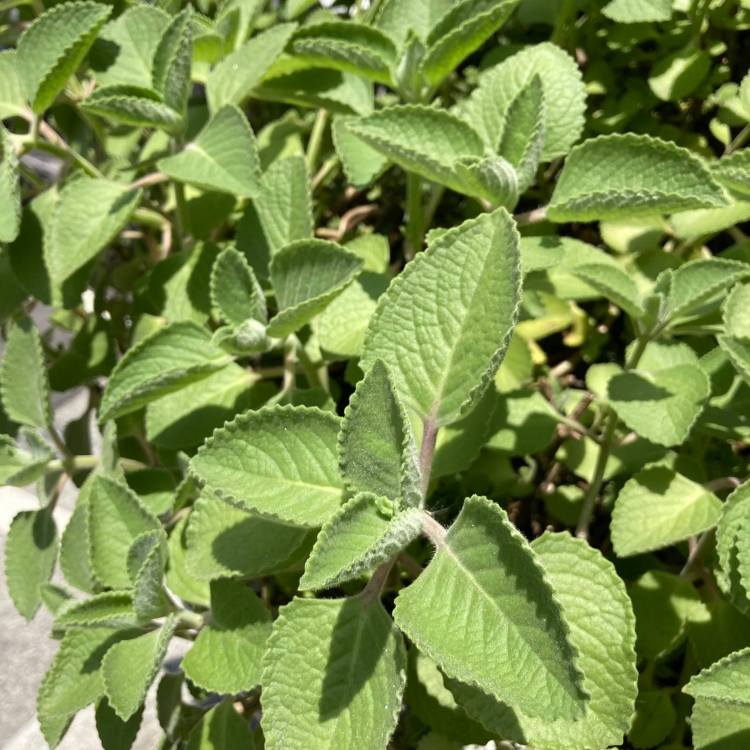
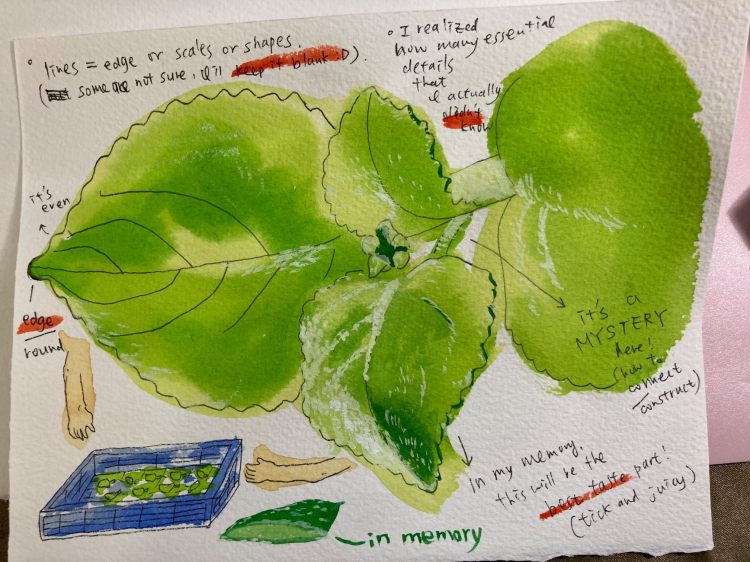
When I drew it in the workshop, I realized that I could distinguish which part of the leaf I don’t know- in the past, I pretended that I could draw some lines to show that it is a leaf. However, since I only had a picture in my hand, it’s enjoyable to realize the details of Coleus amboinicus I don’t know. For instance, the edges of the leaf were round instead of sharp; “veins" were parallel to the central vein till the edge of the leaf. And I also kept some MYSTERY parts blank. (Cause no matter how zoomed-in I did to the picture, I still only got one perspective). It might echo what Trevor recommended to us to “observe overtime/ return" so that I could pick up different images of the same leaf at other times. Or tried different lights, “backlighting" for instance.
Besides, I did highlight the tastiest part. It was fun to recall this even though I haven’t tried it for such a long time. I remember its bitter-herbal taste, and even learned that it is called “jinten" in Indonesia, by sharing with other participants!
Surprise and Enjoyable
To conclude, here I experienced how the act of “drawing (for participants who are adults)” could related to art project, and not limited by the style of painting. Always recall how fun and surprise we will be by observing plants again and again, is the key that made our mind open for the combing of art and nature.
A small clip of memory could indeed link to the environment we are living now, and it was very natural to talk about how we look and how we transform this impression. And I guess those dialogues, images we created, will be one of the interesting ways to approaching ‘ecological conservation’, and it is welcoming everyone!
Story of Coleus Amboinicus: Its tick and furry texture were impressive for me back to my childhood when I first saw it. My first time was in the first year of the elementary school in New Taipei City. That time, our teacher asked all of us (30 kids) to eat a leaf every morning- before classes started. We treated it like a proper vegetable (as if in the kitchen at home): cleaning, drying by the wind a bit, and eating it with clean hands. And actually, you might wonder where are those “Coleus amboinicus" from? They’re planted right beside the window/wall of our classroom. That’s my kind of the first impression of a herbal taste, mixed with a sense of order/rules from an authority, formed as “we’re the only group of kids EAT GRASS every day with rigorous ways of eating." Last but not least, I did enjoy the taste.
 Seeding Future